Display Panel
Display Panel Solutions
The display industry is moving toward larger and more flexible panels.
Scroll to Explore
Overview
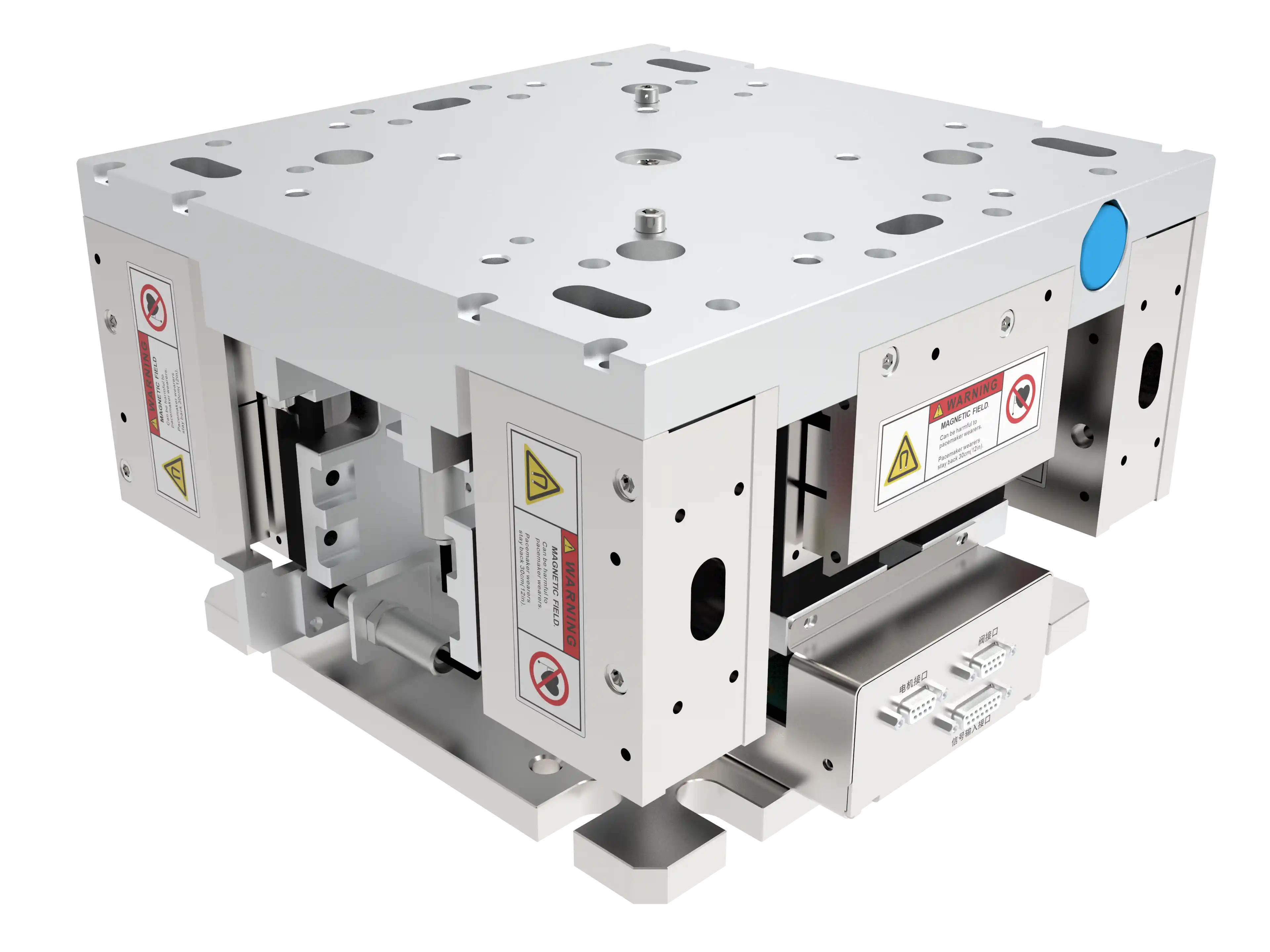
High-Precision Active Vibration Isolators

Vibration Bottlenecks for Large-Size Flexible Displays As display technology advances toward larger formats and flexible architectures, precision requirements become more demanding. G10.5 glass substrates cover nearly 10 m² while tolerating sub-micron vibration only. Minute vibration causes circuit pattern shift and uneven evaporated film thickness. Flexible OLED evaporation is especially sensitive, with pixel offset tolerance at the micron level. Passive isolation cannot effectively suppress vibration below 200 Hz, leading to yield loss and restricting mass production of large-size flexible displays.


Pain Point Analysis
In-Depth Analysis of Industry Pain Points
Precision Challenges from Larger Panel Formats
G10.5 glass substrates span nearly 10 m² with sub-micron vibration tolerance. Low-frequency vibration at 5 Hz triggers pattern shift and uneven film deposition.
Our Solutions:

Quasi-zero-stiffness technology achieving natural frequency below 0.5 Hz

Active vibration control system to counteract sub-Hertz vibrations in real time

Low-frequency sensors for capturing faint vibration signals

Trade-off Between High-Speed Motion and Fast Settling
Substrates experience high acceleration during conveyance and require rapid stabilization after positioning. Inertia from transmission handle induces low-frequency jitter and reduces throughput.
Our Solutions:

Ultra-fast active vibration response of 5–20 ms

Feedforward control cutting settling time by over 70%

Coordinated motion control and active isolation, combining high-performance vibration suppression with nanometer positioning

High Speed Fluctuation & Uneven Motion
Large glass substrate handling, precision alignment, and panel inspection require highly uniform motion. Speed fluctuations can cause positioning errors and reduce display manufacturing yield.Conventional drive control solutions suffer from obvious speed fluctuation, causing machining trajectory deviation and uneven pattern edges, which degrade chip performance.
Our Solutions:

Combining a multi-processor architecture with powerful servo control algorithms, it precisely adjusts motion speed to reduce fluctuation while shortening system settling time. A single module supports up to 8 servo drives and 64 servo axes, adapting to multi-axis linkage scenarios in semiconductor production lines and comprehensively improving motion system stability and efficiency.

Related Products
What are We Using in the Solution?
01
/
03
Let’s Talk About Your Project!
Company *
Name *
E-Mail *
Verification Code *
Send
Specific Requirements *

I have read and agree to the Privacy Policy

Submit
Appointment Engineer 1V1 Consultation
Company *
Name *
E-Mail *
Verification Code *
Send
Specific Requirements *

I have read and agree to the Privacy Policy

Submit
Get your documents now
Please complete the form below. After submission, refresh the page to download your files.
Company *
Name *
E-Mail *
Verification Code *
Send
Specific Requirements *

I have read and agree to the Privacy Policy

Submit